Q-01
What is a Healthcare Middleware Integration Framework, and how
does it help integration?
A Healthcare Middleware Integration Framework acts as a
central layer that connects multiple healthcare systems such as
EHRs, LIS, and patient apps. It simplifies
middleware data integration by translating and routing
data between different formats like HL7, FHIR, and JSON. With a
ready-to-use middleware API and pre-built connectors,
healthcare organizations can accelerate interoperability, ensure
compliance, and reduce integration time and costs.
Q-02
How is integration middleware different from traditional APIs
or direct connectors?
While traditional APIs connect two systems directly,application integration middleware
provides a scalable, secure, and centralized layer for
communication across multiple applications. It manages data
orchestration, transformation, and error handling while
maintaining reliability and compliance across the ecosystem.
Q-03
Why should I use Emorphis’s Healthcare Middleware Integration
instead of building one internally?
Building your own
Healthcare Middleware Integration requires significant
engineering time, compliance validation, and testing. Emorphis
provides a pre-built, compliant integration
middleware software framework that is ready for
deployment. With our
integration middleware development expertise , you can
launch 5X faster, minimize QA cycles, and maintain HIPAA
compliance without starting from scratch.
Q-04
Which standards and healthcare data formats does your
middleware support?
The
Healthcare Middleware Integration Framework supports
all major healthcare interoperability standards including:
- HL7 v2/v3, FHIR, DICOM, and CCD
-
REST, SOAP, and event-driven messaging This makes it one of
the top middleware integration solutions for
healthcare providers, ISVs, and digital health startups.
Q-05
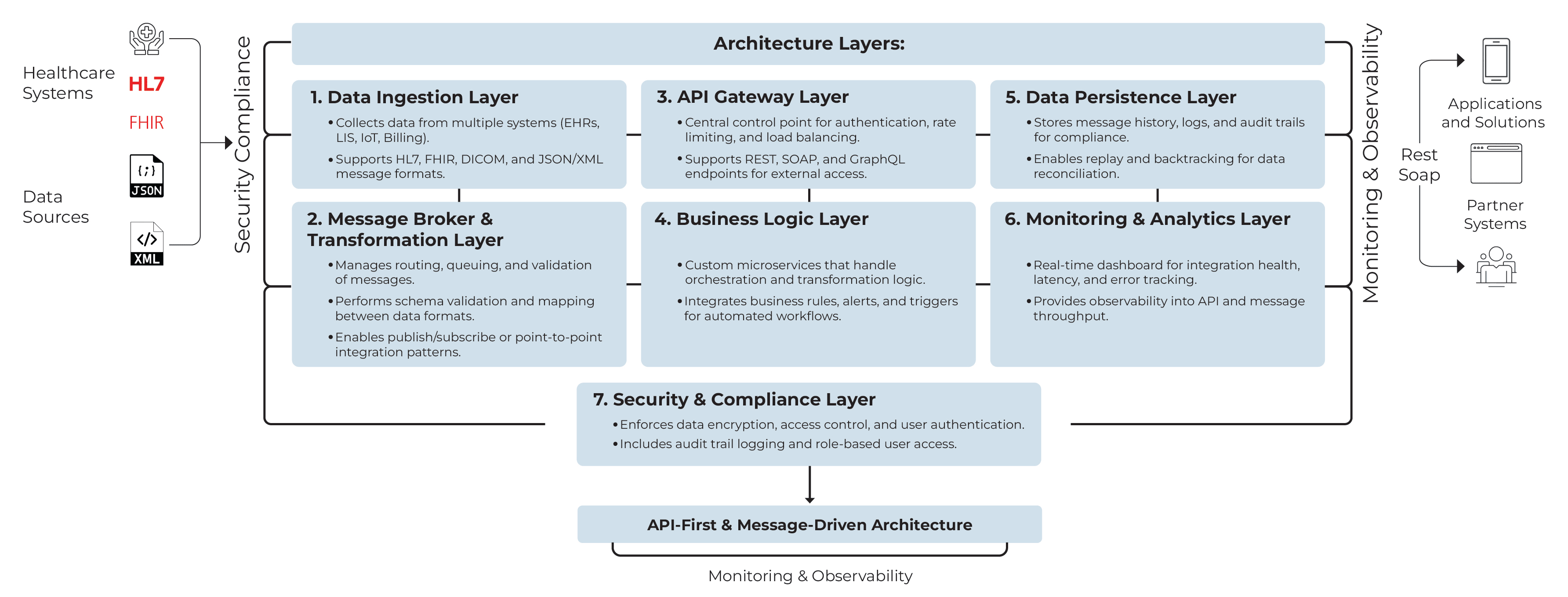
What are the main components of your middleware
architecture?
The Emorphis framework includes:
-
Middleware API Gateway for secure and controlled
access
-
Integration Layer for data orchestration and routing
-
Connector Library for EHRs like OpenEMR, Epic,
Cerner, and AthenaHealth
-
Monitoring Layer for observability and analytics
-
Security and Compliance Layer for HIPAA, SOC2, and 21
CFR Part 11 compliance
Together, these middleware tools for integration create a reliable
and scalable architecture that fits any healthcare IT environment.
Q-06
Is your middleware compatible with open-source integration
tools?
Yes. The Emorphis solution supports and extends
open-source middleware integration tools such as
Mule ESB, Apache Camel, and WSO2. This approach
provides flexibility, cost efficiency, and enterprise-grade
reliability under one integration framework.
Q-07
How secure is the framework, and how do you ensure
compliance?
Security and compliance are foundational to our design. The
Healthcare Middleware Integration Framework uses TLS 1.3, AES-256
encryption, OAuth 2.0, and JWT authentication to safeguard all
data exchanges. It meets HIPAA, GDPR, and 21 CFR Part 11
requirements, making Emorphis a trusted middleware provider in
regulated healthcare environments.
Q-08
Who can benefit from adopting this healthcare middleware
framework?
This solution is ideal for:
-
Healthcare ISVs and software integrators developing connected
systems
-
Hospitals and clinics improving interoperability across
internal tools
-
Digital health startups seeking secure and quick integration
-
Healthcare SaaS providers looking for scalable application
integration middleware
Emorphis works as a dedicated integration middleware partner
helping teams achieve faster and compliant interoperability.
Q-09
Does Emorphis provide middleware integration services along
with the framework?
Yes. We offer complete middleware integration services along with
the framework. From architecture setup to QA and ongoing
monitoring, our experts handle every technical aspect. This
ensures seamless deployment and lifecycle support while keeping
your integration secure and optimized.
Q-10
Who is the Accelerative AI Framework best suited for?
It’s ideal for enterprise leaders, CTOs, and innovation teams
looking to fast-track AI adoption with a scalable, cost-effective,
and secure foundation.
Q-11
Can the middleware be deployed in any cloud or hybrid
environment?
Absolutely. The framework is cloud-agnostic and can be deployed on
AWS, Azure, or GCP. It supports Kubernetes-based scalability and
containerized deployments. Whether you are using best application
integration platforms or custom on-premise setups, the Emorphis
middleware integrates easily with existing environments.
Q-12
What is the difference between middleware frameworks and
application integration platforms?
Middleware frameworks provide the underlying infrastructure for
handling communication, transformation, and orchestration between
systems. Application Integration Platforms like MuleSoft or Boomi
offer user-friendly interfaces built on top of such frameworks.
The Emorphis Healthcare Middleware Integration Framework delivers
the strengths of both, robust architecture with intuitive
integration management.
Q-13
How customizable is the Emorphis middleware for
healthcare-specific use cases?
The integration middleware is highly configurable and adaptable.
You can customize modules for:
- HL7 or FHIR-based data exchange
- Patient and provider synchronization
- Telehealth or IoMT integrations
- Analytics and clinical workflow automation
This flexibility enables scalable integration middleware
development aligned to your operational and compliance needs.
Q-14
Who are the leading HL7 middleware vendors, and where does
Emorphis stand?
There are several HL7 middleware vendors offering generic
integration tools, but Emorphis stands apart as a
healthcare-focused middleware provider offering an end-to-end
interoperability framework. Our expertise spans middleware
software, application integration middleware, and middleware
integration services with a proven record in healthcare
implementations.
Q-15
How can Emorphis support my integration and interoperability
journey?
Emorphis can act as your software integrator and integration
middleware partner to help you unify healthcare systems
efficiently. Our Healthcare Middleware Integration Framework is
pre-tested, compliant, and designed for rapid deployment. It helps
healthcare organizations achieve interoperability, security, and
scalability without unnecessary complexity.
Q-16
What types of integrations are supported by the Healthcare
Integration Middleware Framework?
The framework supports multiple integration types, including HL7,
FHIR, and DICOM for EHR systems; API-based integrations for cloud
platforms like AWS, Azure, and Google Cloud; and device data
integration for IoT-enabled medical equipment. It also supports
middleware API connections between legacy healthcare systems and
modern applications, ensuring seamless interoperability.
Q-17
What can be connected with the Healthcare Middleware
Integration framework?
Here’s a structured breakdown of what can be connected with
healthcare middleware, categorized by system type and integration
purpose: a. Core Healthcare Systems These are the primary systems
middleware connects to enable interoperability across the
healthcare ecosystem.
-
Electronic Health Records (EHR / EMR): Epic, Cerner,
Allscripts, Meditech, AthenaHealth, and more. Middleware
handles HL7, FHIR, or API-based exchange for patient data,
encounters, orders, and results.
-
Laboratory Information Systems (LIS): Sunquest, Orchard,
Cerner LIS. Integrates test orders, results, and specimen
tracking into EHRs or analytics systems.
-
Radiology Information Systems (RIS) & PACS: GE, Fuji, Philips,
Merge Healthcare. Enables DICOM image transfer, radiology
report exchange, and integration with physician dashboards.
-
Pharmacy Management Systems: Cerner Pharmacy, PioneerRx,
Omnicell. Middleware enables e-prescription workflows, drug
dispensing data, and formulary updates.
b. Administrative & Financial Systems Middleware ensures
operational systems communicate seamlessly with clinical ones.
-
Practice Management Systems (PMS): Appointment scheduling,
claims processing, and patient demographics sync with EHR.
-
Revenue Cycle Management (RCM): Enables smooth data flow for
billing, insurance eligibility checks, and payment
reconciliation.
-
ERP & HR Systems (SAP, Oracle, Workday): Connects clinical
operations with workforce management, procurement, and
inventory.
-
CRM Platforms (Salesforce Health Cloud, Microsoft Dynamics):
Facilitates patient engagement, marketing, and referral
management.
c. Connected Health Ecosystems Modern healthcare requires
integration beyond hospital walls. Middleware enables this
expansion.
-
Telehealth Platforms: Connects video consultation systems and
remote diagnostics with EHRs and patient records.
-
Remote Patient Monitoring (RPM) Devices: Integrates wearable
and IoT device data (vital signs, glucose monitors, heart rate
sensors) into clinical dashboards.
-
Patient Portals and Mobile Apps: Middleware ensures secure,
real-time access to health summaries, lab results, and care
plans.
-
Healthcare Chatbots & Virtual Assistants: Provides contextual
responses using integrated clinical and operational data.
d. Data Analytics and Intelligence Systems Middleware feeds data
pipelines for decision support, research, and analytics.
-
Clinical Data Repositories (CDR) & Data Lakes: Aggregates
structured and unstructured data from multiple sources.
-
AI/ML Models & Predictive Analytics Engines: Supplies clean,
normalized data for risk prediction, disease progression, and
outcomes modeling.
-
BI and Reporting Tools: Power BI, Tableau, Qlik. Middleware
delivers data marts or APIs for performance dashboards and
regulatory reporting.
e. External & Regulatory Systems Compliance often requires secure,
auditable data exchange with external entities.
-
Health Information Exchanges (HIEs): Enables participation in
regional or national interoperability networks.
-
Payers and Insurance Systems: Middleware manages eligibility
verification, claims submission, and EOB data exchange.
-
Public Health Registries & Research Databases: Facilitates
automated reporting for immunizations, notifiable diseases, or
clinical trials.
-
Third-Party Integrations: Connects with APIs for scheduling,
authentication (SSO, OAuth), or cloud data storage (AWS
HealthLake, Azure API for FHIR).
f. Infrastructure and Cloud Services Middleware can also tie
together infrastructure-level systems for scalability and
monitoring.
-
API Gateways & Microservices: Manages internal service
communication securely and efficiently.
-
Cloud Platforms (AWS, Azure, GCP): Middleware can integrate
compute, storage, and analytics services directly.
-
DevOps and Monitoring Tools: Connects CI/CD pipelines,
logging, and observability layers for end-to-end management.
Q-18
What is the cost of integration using the healthcare middleware
integration Middleware Framework?
The cost depends on several factors including the number of
integrations, complexity of APIs, data volume, and compliance
requirements. Emorphis offers flexible pricing models based on the
scope of integration. Since we have a ready-to-deploy middleware
framework, you save both time and cost—typically achieving
integration up to 5X faster than custom-built solutions.
Q-19
What happens after post-deployment of integration
middleware?
After deployment, our team provides continuous support for
performance optimization, security audits, and compliance
monitoring. As your integration middleware partner, we ensure
ongoing updates for HL7/FHIR standards, manage API lifecycle, and
provide QA validation for all data flows. This helps maintain data
accuracy, system reliability, and compliance with HIPAA and other
healthcare standards.